
Canada’s higher education and postgraduate training systems are crucial part of the scientific enterprise, but they are not yet fully aligned with the needs of an inclusive, innovation-driven society and economy. Current disruptions – AI, shifting geo-political landscape, emerging societal issues – are redefining the role of research, talent and highly qualified personnel, in ways that amplify the urgency to rethink how we frame the value of graduate and postgraduate studies, as well as expectations as to what constitutes success and meaningful outcomes in graduate education.
How can graduate education ensure that students are taught and can hone the foundational collaborative research competencies, including innovation and impact literacy, and go on to access opportunities that fully showcase the value of graduate training across the social, cultural, environmental, and economic sectors to drive and contribute to Canada’s prosperity?
Specifically, Canada’s graduate education systems need to be re-designed and resourced to consistently produce and deploy the kind of interdisciplinary, equity-minded, impact-oriented talent that the country’s innovation ecosystems need. However, efforts are often impeded by persistent issues:
- Graduate programs remain siloed within disciplines, which limits emerging researchers’ ability to work across sectors and address complex social, cultural, environmental, and technological challenges.
- Funding and incentive structures (for students, programs, and faculty) rarely reward interdisciplinarity, inclusive practices, or non-academic career pathways.
- Experiential and work-integrated learning opportunities for graduate students are unevenly distributed and often under-resourced, especially in social science and humanities, and by extension in community and non-profit sectors.
- Innovation and impact literacy are not systematically embedded in graduate curricula.
- Equitable access to graduate studies — especially for Indigenous and other equity deserving groups — is not yet guaranteed, which points to issues with the pipeline effects from primary and secondary education.
Learn more about the Federation’s Big Thinking Summit series
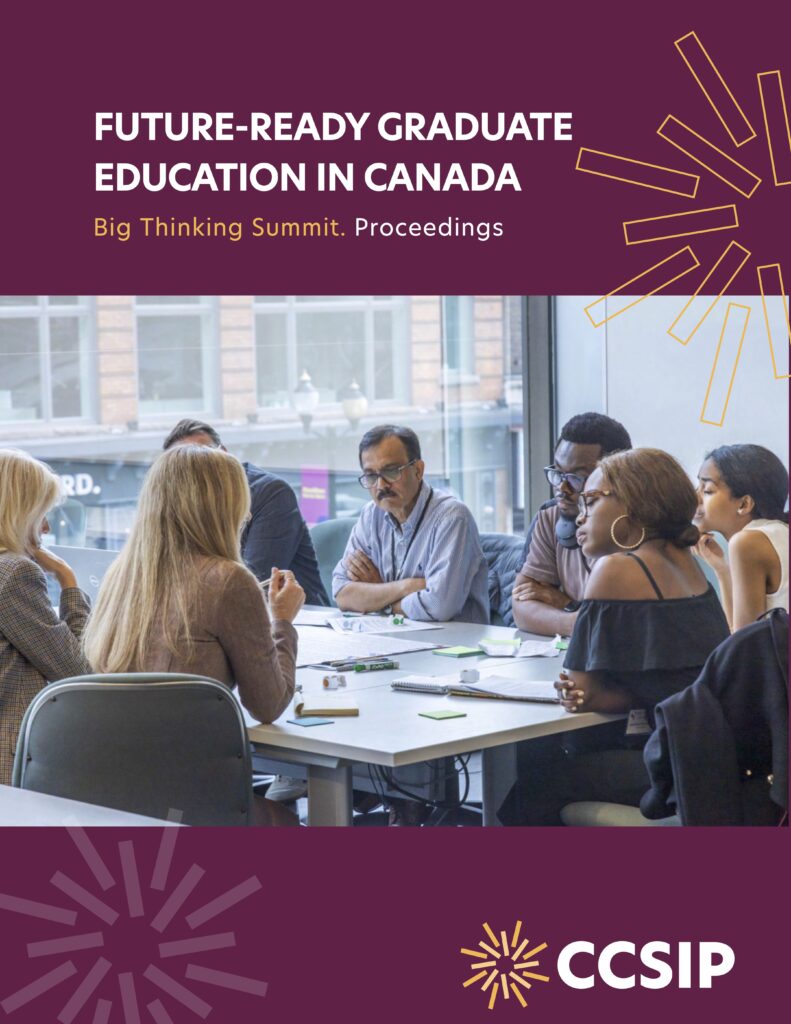
On 15-16 October 2025, 100 guests and speakers gathered at McMaster University, on the invitation of the Federation for the Humanities and Social Sciences, the Canadian Association for Graduate Studies and the Canadian Collaborative for Society, Innovation and Policy to deliberate and catalyse discussion around 5 recommendations for Canada’s graduate education systems.